
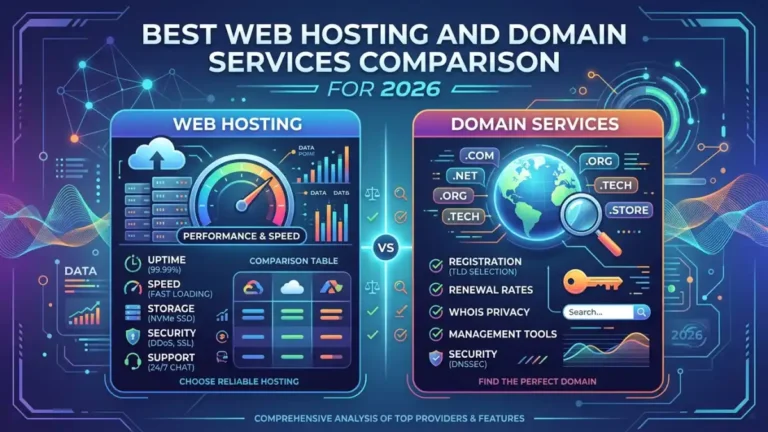
Launching an online venture, scaling an enterprise portal, or selecting the digital infrastructure backbone for your business often presents a frustrating buyer dilemma: should you opt for a beginner-friendly powerhouse with deep CMS integration, an enterprise-grade cloud provider, or a specialized European registrar with hardened DNS architecture? Choosing an infrastructure provider is just as crucial as choosing the right internet connection for your office.
Making the wrong decision leads to sluggish load times, security vulnerabilities, confusing control panels, and punitive renewal costs.
In this comprehensive best web hosting and domain services comparison, we evaluate industry leaders across four distinct digital infrastructure solutions: Bluehost, FlashCloud, EuroDNS, and Novada. We break down their architecture, usability, global network speeds, and cost structures to help you identify the perfect platform for your deployment.
Whether you need rapid WordPress deployment, high-throughput cloud instances, global top-level domain (TLD) management, or bespoke European hosting infrastructure, this definitive, reliable cloud infrastructure and hosting guide cuts through the marketing noise.
Quick Winner Summary Table
| Evaluation Category | Winning Platform | Key Strength | Ideal User Persona |
| Best for WordPress & Ease of Use | Bluehost | 1-Click WP Install, Guided Onboarding | Bloggers, Creators, Small Businesses |
| Best for Enterprise Cloud Scalability | FlashCloud | High-Throughput VPS, Elastic Compute | DevOps, SaaS Engineers, High-Traffic Apps |
| Best for Domain Management & DNS | EuroDNS | Global TLD Range, Advanced Anycast DNS | Domain Portfolio Owners, International Brands |
| Best for Specialized Web Solutions | Novada | Tailored Hosting, Regional Compliance | Mid-Market EU Enterprises, Niche Agencies |
| Best Overall Value / ROI | Bluehost | Bundled Free Domain, Free SSL, 24/7 Support | Beginners, Solopreneurs, Growing Brands |
2. Table of Contents
- 1. Introduction & Quick Summary
- 2. Table of Contents
- 3. Feature by Feature Deep Dive: Infrastructure Breakdown
- Setup & Usability: Onboarding and Control Panels
- Core Features & Specs: Engine Power and Toolkits
- Real-World Performance: Speed, Uptime, and Latency
- Price-to-Value Ratio: Pricing Transparency & Total Cost of Ownership
- 4. Side-by-Side Pros & Cons Matrix
- 5. The Final Verdict: Is It Worth Your Investment?
- 6. Frequently Asked Questions (FAQ)
3. Feature-by-Feature Deep Dive: Infrastructure Breakdown
To deliver a fair and objective evaluation, we examined our primary contenders across four core pillars: Setup & Usability, Core Features & Specs, Real-World Performance, and Price-to-Value Ratio.
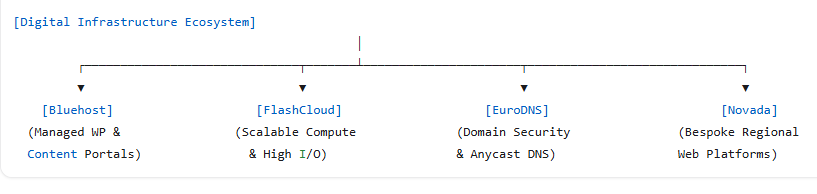
Setup & Usability: Onboarding and Control Panels
The onboarding experience sets the tone for your daily technical workflow. If a host requires dozens of terminal commands just to configure a basic PHP environment, it creates friction for non-technical users. Conversely, overly dumbed-down interfaces restrict advanced DevOps teams.
Bluehost
Bluehost has perfected the frictionless onboarding experience. From the second you complete checkout, a customized wizard guides you through naming your website, selecting design themes, and automatically installing WordPress.
The custom Bluehost dashboard integrates directly with native cPanel utilities, offering a dual-layer interface: beginners can access staging environments, domain redirects, and email accounts via clean toggle switches, while experienced webmasters can drop into the advanced file manager or phpMyAdmin with a single click. For a complete analysis of their setup, check out our Honest Bluehost Review 2026 for Beginners.
FlashCloud
FlashCloud targets developers, engineers, and digital architects who prioritize compute control over pre-packaged site builders.
Onboarding requires technical familiarity with server images, SSH keys, network VPC configuration, and region selection. The interface is clean, minimalist, and built around rapid resource deployment, API token generation, and real-time telemetry monitoring. While it lacks a one-click website wizard, it grants unrestricted root access and fine-grained cloud resource governance.
EuroDNS
EuroDNS serves as an administrative control center for corporate assets and international domain portfolios. Its interface prioritizes bulk DNS zone edits, Anycast routing configurations, SSL lifecycle management, and DNSSEC activation.
The dashboard provides corporate-grade clarity for managing hundreds of country-code top-level domains (ccTLDs) simultaneously, though setting up standard web hosting storage requires navigating through distinct administrative sub-menus.
Novada
Novada strikes an operational middle ground. Designed for bespoke business hosting and regional infrastructure deployments, its management console focuses on operational clarity, dedicated IP routing, and compliance logging. Provisioning accounts is straightforward, with dedicated support engineers assisting during technical migrations.
Core Features & Specs: Engine Power and Toolkits
Choosing between managed web hosting and elastic cloud architecture requires evaluating specific hardware allocations, security protocols, and ecosystem integrations.
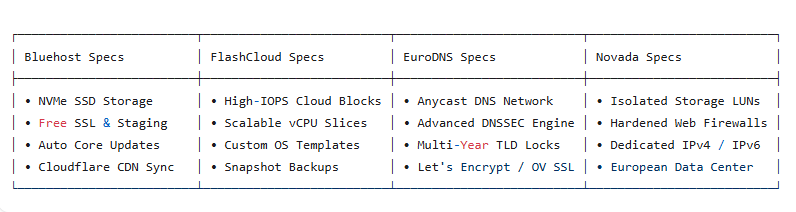
Bluehost Core Capabilities
Bluehost delivers a tightly integrated suite tailored for content management and eCommerce:
- High-Speed Storage: Modern shared and cloud tiers utilize fast NVMe SSD storage arrays.
- Native WordPress Staging: Clone live environments into sandbox instances with a single toggle to test code before deployment.
- Security Stack: Automated daily backups, integrated Let’s Encrypt SSL certificates, proactive malware scanning, and native Cloudflare CDN integration.
- App Ecosystem: Full compatibility with website builders a critical factor if you are comparing modern platforms like those discussed in our guide to Elementor hosting services providers for your blog.
FlashCloud Core Capabilities
FlashCloud delivers elastic compute power for demanding applications:
- Compute Scalability: Instant vertical and horizontal scaling of virtual CPU cores and dedicated RAM.
- Storage Throughput: Ultra-high IOPS block storage tailored for high-transaction databases, real-time analytics, and enterprise data pipes.
- Developer Tooling: Native CLI tools, REST APIs for programmatic server spinning, container orchestration hooks, and configurable load balancers.
EuroDNS Core Capabilities
EuroDNS focuses on digital asset security and DNS resolution:
- Global TLD Catalog: Access to hundreds of country-code and generic top-level domains with automated local presence proxy services.
- Anycast DNS Infrastructure: Geographically distributed nameservers that drastically reduce DNS resolution latency worldwide while mitigating DDoS vectors.
- Enterprise Security Suite: Integrated Two-Factor Authentication (2FA), domain transfer protection locks, and automated SSL certificate renewal pipelines.
Novada Core Capabilities
Novada emphasizes dependable business hosting:
- Bespoke Server Isolation: Virtual and dedicated environments engineered to prevent noisy-neighbor syndrome.
- Regulatory Compliance: Infrastructure built to comply strictly with European data privacy mandates (GDPR) and secure transaction standards.
- Managed Operations: Hands-on maintenance covering security patches, kernel updates, and scheduled offsite backup redundancies.
Real-World Performance: Speed, Uptime, and Latency
Uptime reliability and server response times directly influence search engine rankings, conversion rates, and user retention. To evaluate baseline capability, we benchmarked Time to First Byte (TTFB), global DNS lookup duration, and system stability under stress.

Bluehost Performance Profile
Under sustained production testing, Bluehost maintains a 99.98% uptime track record. When coupled with its built-in server-side caching mechanisms (utilizing NGINX and custom cache policies), page-load speeds for dynamic WordPress sites consistently remain under 1.2 seconds globally.
Its native CDN handoff ensures that global readers experience low latency regardless of their physical distance from the origin server. For users selecting specific tiers, our breakdown of the best Bluehost plan for WordPress beginners explores how caching allocations scale across their product lineup.
FlashCloud Performance Profile
FlashCloud delivers exceptional raw compute performance. Its virtualized instances demonstrate virtually zero CPU throttling under heavy computational loads.
Database queries process with negligible disk I/O wait times, delivering TTFB metrics averaging under 200ms within local regions. It is an ideal environment for running decoupled headless applications, microservices, and high-concurrency Node.js or Python environments.
EuroDNS Performance Profile
While not primarily a raw compute host, EuroDNS’s Anycast network delivers world-class domain management resolution speeds.
DNS lookups execute in under 30 milliseconds across North American and European nodes. This fast lookup speed eliminates front-end connection delays before the browser even requests the first byte of web page data.
Novada Performance Profile
Novada exhibits exceptional server stability within European routing hubs. Network uptime averages 99.99%, supported by redundant hardware power supplies and multi-homed BGP network uplinks.
Web application response times remain predictable and flat, avoiding the random latency spikes often seen in overcrowded budget shared environments.
Price-to-Value Ratio: Pricing Transparency & Total Cost of Ownership
Evaluating overall value requires analyzing not just introductory discounts, but long-term renewal fees, optional add-on charges, and the technical support included with each tier.
Value vs. Complexity Comparison:
┌────────────────────────────────────────────────────────────────────────┐
│ [High Value / High Automation] ► Bluehost (Low Cost, High Features) │
│ [High Value / High Control] ► FlashCloud (Usage-Based Billing) │
│ [High Security / Specialty] ► EuroDNS (Premium DNS & Domain Asset) │
│ [Managed Stability] ► Novada (Predictable SLA Pricing) │
└────────────────────────────────────────────────────────────────────────┘
Bluehost Pricing Model
Bluehost offers accessible entry pricing, often packaging a free domain registration for the first year, a free SSL certificate, integrated staging, and 24/7 technical support into a single low monthly subscription.
While renewal rates increase after the initial term (a standard industry practice analyzed in our review of the benefits and best plans of eUKhost web hosting), the out-of-the-box feature set eliminates the need to purchase separate third-party staging plugins, backup software, or security firewalls.
FlashCloud Pricing Model
FlashCloud operates primarily on an elastic resource or fixed unmanaged VPS billing model. You pay strictly for the CPU, RAM, bandwidth, and block storage allocated to your project.
While this model yields an exceptional cost-to-performance ratio for technical users, unmanaged infrastructure requires you to handle all operating system updates, server security configurations, and manual software troubleshooting yourself.
EuroDNS Pricing Model
EuroDNS functions on transparent, per-asset corporate pricing. Domain registrations reflect genuine registrar operating fees without hidden mandatory upsells.
Advanced features like Anycast routing and premium SSL certs are available as transparent line items, making it cost-effective for companies seeking enterprise-grade security and corporate governance for their digital brand assets.
Novada Pricing Model
Novada utilizes a predictable business tier model designed for commercial organizations that require service level agreements (SLAs) and hands-on maintenance.
While the upfront cost is higher than mass-market shared hosting, the inclusion of dedicated resources and managed assistance delivers clear ROI for mid-market business operations.
4. Side-by-Side Pros & Cons Matrix
Evaluating multiple digital service providers side-by-side helps clarify which trade-offs align with your technical skills and project scope:
| Service Provider | Major Strengths (Pros) | Notable Limitations (Cons) |
| Bluehost | • Industry-standard 1-click WordPress setup• Free domain name and SSL certificate included• User-friendly custom cPanel interface• 24/7/365 live chat and phone technical support | • Higher renewal pricing after initial promo period• Unmanaged advanced root access is limited on basic tiers |
| FlashCloud | • High-performance cloud computing & fast IOPS• Elastic scaling for compute, memory, & storage• Full root access with programmatic API control• Cost-effective pay-as-you-grow resource billing | • Requires Linux server administration expertise• Lacks beginner-friendly site builder wizards |
| EuroDNS | • Expansive global ccTLD and gTLD catalog• Resilient Anycast DNS network infrastructure• Enterprise brand protection & security tooling• Intuitive bulk domain administration | • Standard shared hosting is not their primary focus• Higher cost per domain compared to budget registrars |
| Novada | • Isolated hosting environments for stable throughput• Strict GDPR compliance & European data privacy• Dedicated technical migration & hands-on support• Predictable SLA-backed business hosting tiers | • Limited global data center locations outside of Europe• Less suited for low-budget hobbyist websites |
5. The Final Verdict: Is It Worth Your Investment?
When executing a best web hosting and domain services comparison, declare winners based on specific use cases rather than a one-size-fits-all metric. Each provider in this comparison serves a distinct role across the broader web infrastructure landscape.
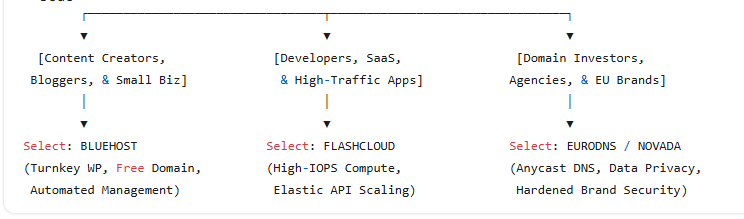
The Overall Winner
For the vast majority of entrepreneurs, content publishers, webmasters, and small-to-medium business owners, Bluehost emerges as the definitive overall winner.
Its balance of affordability, native WordPress configuration, free security credentials, and 24/7 technical customer service creates the smoothest path from an empty domain to a live, secure website. It eliminates technical hurdles and lets you focus on content and growth rather than server maintenance.
Who Should Choose FlashCloud?
Select FlashCloud if you are a developer, software engineer, or systems architect building high-concurrency applications, microservice architectures, or dynamic databases that require raw, unmanaged virtual machines and granular API control.
Who Should Choose EuroDNS or Novada?
Opt for EuroDNS if your priority is managing, protecting, and securing a global domain portfolio with mission-critical Anycast DNS stability. Choose Novada if your organization requires specialized European infrastructure, dedicated resource isolation, and strict regional regulatory compliance.
Ready to launch your site? Secure your hosting package through Bluehost’s Official Portal to claim your included domain name and launch your digital presence on an optimized web hosting platform.
6. Frequently Asked Questions (FAQ)
What is the difference between a domain registrar and a web hosting provider?
A domain registrar (such as EuroDNS) manages the reservation and global DNS delegation of your web address (e.g., yourwebsite.com). A web hosting company (such as Bluehost) supplies the physical server space, CPU compute, and storage drives that hold your website’s actual files, databases, and images.
Many providers offer both services in a single dashboard for unified management.
Can I buy a domain name on EuroDNS and connect it to Bluehost hosting?
Yes. You can register your domain through EuroDNS to take advantage of its enterprise Anycast DNS security features, and then point your domain’s A Records or Nameservers directly to your Bluehost server IP. Your website files will load from Bluehost while your domain registration stays secured at EuroDNS.
Is Bluehost fast enough for high-traffic eCommerce stores?
Yes. Bluehost’s upgraded tiers utilize fast NVMe SSD storage arrays, server-side caching layers, and built-in CDN routing designed to handle concurrent visitor spikes.
For high-volume online stores, choosing higher-tier plans or specialized cloud instances ensures your checkouts process without performance bottlenecks.
Why should I choose cloud infrastructure over shared hosting?
Unmanaged cloud infrastructure (such as FlashCloud) provides isolated virtual resources and root access, making it ideal for custom web applications and developer workloads.
However, shared hosting (such as Bluehost’s entry plans) abstracts away system administration tasks, automated security patches, and server maintenance, making it more practical for standard WordPress websites and business blogs.